
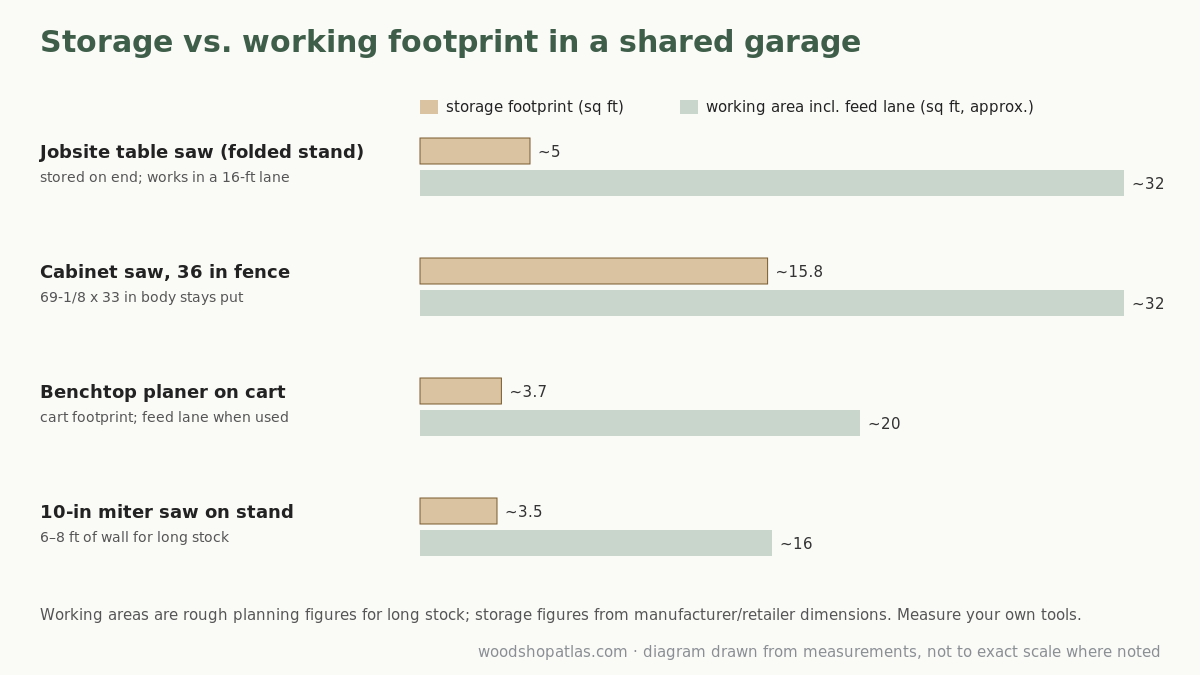
In a garage you share with a car, choose portable and benchtop tools for anything that needs a big working area, and save stationary machines for the spot that never has to move. A jobsite table saw on a folding stand, a benchtop planer on a cart and a miter saw on a folding stand can all pack into a corner when the car comes in. A cabinet saw can’t: the SawStop Professional Cabinet Saw with a 36-in fence covers 69-1/8 x 33 in (176 x 84 cm) and weighs 426 lb (193 kg) (SawStop). Go stationary when you have a dedicated space, a project mix that needs the extra capacity, and the power supply to run it.
Three classes of tools, not two
“Portable vs. stationary” really covers three groups:
- Portable (handheld): circular saw, track saw, jigsaw, router, sanders, drill. They go to the work and store in cases or drawers.
- Benchtop and jobsite: jobsite table saws, benchtop planers, miter saws, benchtop drill presses and bandsaws. They need a surface or stand but can be carried (with effort) and stored on a shelf or a cart.
- Stationary: cabinet and hybrid table saws, floor-standing bandsaws, jointers, larger planers, dust collectors. They’re heavy, often need their own circuit, and are meant to stay put (or move only on a mobile base).
The shared-garage question is about the middle group: how much benchtop and jobsite capability you can get before you need a stationary machine.
Storage mode vs. working mode
Every tool in a shared garage has two footprints: where it sits when the car is in (storage mode) and how much floor it needs while you use it (working mode). Spec sheets give you neither directly, so here are the numbers we could verify:
| Tool | Body size / weight | Working area needed | Storage notes |
|---|---|---|---|
| DeWalt DWE7491RS jobsite table saw | Table 21-7/8 x 26-3/8 in (56 x 67 cm); saw over 55 lb (25 kg), more with the rolling stand (DeWalt manual) | About 16 ft (4.9 m) lane to rip an 8-ft board, plus side room | The rolling stand folds; fence rails retract. Can stand on end or lie flat |
| SawStop PCS, 3 HP, 36 in fence (cabinet saw) | 69-1/8 x 33 x 34 in (176 x 84 x 86 cm), 426 lb (193 kg) | Same lane, plus room at the left for crosscuts | Doesn’t fold. Mobile base possible; still a permanent footprint |
| DeWalt DW735X benchtop planer | About 22 x 24-1/4 x 21-3/4 in (56 x 62 x 55 cm) and 92 lb (42 kg) per retailer listings (Tractor Supply) | Board length in front and behind, plus the folding infeed/outfeed tables | Lives on a shelf or cart; heavy to lift, so a cart is better. See DW735 dimensions and planer stand options |
| DeWalt DWS713 10-in miter saw | About 31 lb (14 kg); roughly 25 x 20 in (63 x 51 cm) per retailer listings | Board support on both sides: 6–8 ft (1.8–2.4 m) of wall for long stock | Fits on a shelf or a folding stand |
Two things jump out. First, the working footprint of a jobsite saw and a cabinet saw is nearly the same, because the board decides it, not the saw. Second, the difference is all in storage mode: one rolls into a corner, the other stays in the middle of the floor. To check both footprints against your own garage and car, use the garage workshop planner.
Jobsite table saw vs. cabinet saw
This is the purchase where the portable/stationary decision bites hardest.
A jobsite saw (like the DWE7491RS) runs on a regular 120 V, 15 A circuit, rolls on its own stand and offers a 32-1/2 in (83 cm) rip capacity to the right of the blade. Its trade-offs are a smaller table, a lighter fence system, a universal motor that’s louder, and more vibration than a heavy cast-iron saw. For cabinet and furniture work in a shared garage it’s a capable tool.
A cabinet saw gives you a large, flat cast-iron top, a heavier fence, more mass to damp vibration, and usually better dust collection. SawStop’s PCS has a 4-in dust port and the company recommends at least 350 CFM of airflow to it, which means a dedicated dust collector rather than a shop vacuum. The 3 HP version needs a 230 V circuit with a NEMA 6-15 plug. SawStop also sells a 1.75 HP version of the same saw. Have an electrician confirm what your garage circuit can support before you buy any saw that needs more than a standard outlet.
Hybrid and contractor saws sit between the two in size and weight. They’re stationary in practice.
For a shared garage: a jobsite saw unless the saw will have its own permanent spot with a 16-ft lane available without moving the car. If you’re unsure whether you need any table saw yet, read track saw vs. table saw for a small workshop first.
Benchtop vs. stationary tools: the other machines
Planer
A 13-in benchtop planer is the standard choice for small shops. At around 92 lb, a DW735-class planer is heavy enough that lifting it from a low shelf every session gets old fast; a dedicated cart at working height is the usual fix. Floor-standing planers handle wider boards and heavier cuts but weigh several times as much. You only need a planer at all if you buy rough or uneven lumber.
Bandsaw
A benchtop bandsaw handles small curves and craft work. A 14-in floor-standing bandsaw is far more capable for resawing and furniture parts, but it’s a tall, top-heavy machine that’s awkward to move. In a shared garage it usually ends up against a wall on a mobile base.
Drill press
A benchtop drill press can share a shelf or a rolling cart with other tools. Floor models add capacity for tall workpieces. Most hobby work fits the benchtop size.
Jointer
Benchtop jointers exist but have short beds that limit straightening long boards. Floor jointers are long machines. Many small shops skip the jointer and buy surfaced lumber, use a planer sled, or straighten edges with a track saw.
Dust collection
A shop vacuum with a cyclone separator handles portable and benchtop tools. Stationary machines usually need a dust collector with more airflow, which is another floor-standing machine to park somewhere.
When stationary tools make sense
Go stationary for a specific machine when all of these are true:
- There’s a spot that never has to move. The back wall of a deep garage, a basement corner, a second bay that doesn’t park a car.
- You use the tool every session, so the setup time of a portable tool actually adds up.
- Your projects need the capacity: wider rips, heavier cuts, resawing, long jointing.
- You have the power and dust collection for it, or a plan and budget to add them.
If one of those is missing, a jobsite or benchtop version usually serves better in a shared garage, even if it’s the less capable tool on paper.
A realistic shared-garage tool kit
Here’s what tends to fit a one-car garage that still parks a car, roughly in the order people add it:
- Handheld: circular saw with a guide (or a track saw), drill/driver, random orbit sander, jigsaw, compact router. All in cases or drawers.
- Benchtop on carts or stands: jobsite table saw on a folding stand, miter saw on a folding stand, benchtop planer on a cart if you buy rough lumber.
- Fixed: a narrow wall bench with a vise and wall storage above it.
- Shop vacuum that serves everything.
That kit stores along one wall and a back corner, and covers most furniture, cabinet and shop projects. For the order to buy the handheld tools, see what to buy after a circular saw and drill. For where they go, see how to plan a woodshop in a garage that still parks a car, and for the bench itself, folding vs. rolling vs. fixed workbenches.
How to check a tool before you buy it
- Find the storage size: folded stand, rails retracted, tables up. Look in the manual, not just the listing, and note whether it can be stored upright.
- Find the working size: table plus the longest board you’ll feed, infeed and outfeed.
- Find its parking spot in your garage, tape it on the floor, and park the car.
- Check the plug and amperage against the outlet you’ll use.
- Check the weight against your back. Anything over about 50 lb (23 kg) that you’ll move every session belongs on wheels.
New to planning a shop? Our guide to measuring equipment shows how to record both footprints for your own tools, the small woodworking shop layout guide covers where they go, and the DWE7491RS dimensions page has the full numbers for the jobsite saw above. Our Start Here page lays out the sequence.
FAQ
What’s the difference between portable and stationary woodworking tools?
Portable tools are handheld or light enough to carry and store on a shelf. Stationary tools are heavy floor machines that stay in one place and often need their own circuit and dust collection.
Is a jobsite table saw good enough for furniture?
For many hobbyists, yes. It runs on a standard outlet, rips up to about 32 in on models like the DWE7491RS, and packs away. A cabinet saw is smoother and more precise over time but needs a permanent spot and often 230 V power.
Are benchtop tools worth it?
In small and shared spaces, usually. They cover most hobby work and store out of the way. Upgrade a specific machine to a stationary version when its limits actually block your projects.
Can I put stationary tools on mobile bases?
Yes, and many small shops do. A mobile base helps you move a heavy machine for cleaning or layout changes, but it doesn’t make a cabinet saw easy to park beside a car every day.