
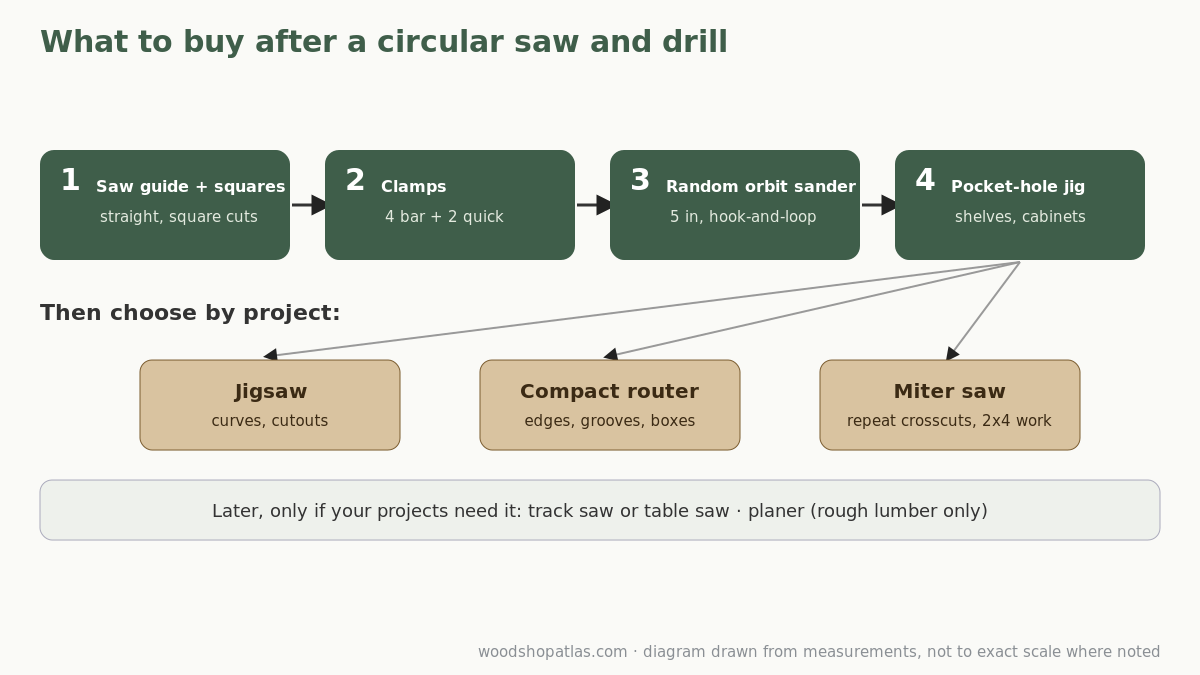
If you already own a circular saw and a drill, buy a straight-cut guide and a good square first, then clamps, then a random orbit sander. Those three make the tools you already have accurate and your projects look finished. After that, let your projects decide: a pocket-hole jig if you’re building shelves and cabinets, a jigsaw for curves, a router for edges and grooves, and a miter saw when you’re making lots of repeated crosscuts. A table saw or track saw can wait longer than most people expect.
Here’s the order, why it works, and how to adjust it for what you build.
The short list, in order
| # | Buy next | What it fixes | Rough cost tier |
|---|---|---|---|
| 1 | Saw guide (straightedge or track-style guide) + combination square + speed square | Crooked cuts and out-of-square parts | Low |
| 2 | Clamps: 4 bar clamps (24–36 in / 61–91 cm) + 2 quick-grip clamps | Glue-ups, holding work while you cut or drill | Low to medium |
| 3 | 5-in random orbit sander | Surfaces that look rough or blotchy after finishing | Low to medium |
| 4 | Pocket-hole jig | Strong, simple joints with just a drill | Low |
| 5a | Jigsaw | Curves, cutouts, notches | Low to medium |
| 5b | Router (compact/trim size first) | Rounded edges, dadoes, grooves, flush trimming | Medium |
| 5c | Miter saw | Fast, repeatable, square crosscuts on boards | Medium |
| 6 | Track saw or table saw | Lots of precise sheet or rip cuts | High |
Items 1–4 are useful to almost everyone. Items 5a–5c depend on what you build. Item 6 is a different decision with its own trade-offs, covered in track saw vs. table saw for a small workshop.
1. Make the circular saw accurate
A circular saw cut freehand along a pencil line will wander. Guided along a straightedge, the same saw can cut plywood cleanly enough for cabinets. That’s the cheapest upgrade in woodworking.
You have two options:
- A shop-made straightedge: a factory edge of plywood or a strip of MDF clamped to the workpiece, offset by the distance from your blade to the edge of the saw’s base. Cheap, and it teaches you to set up a cut.
- A track-style guide for your existing saw. Kreg’s Accu-Cut, for example, mounts most 6-1/2 in and 7-1/4 in circular saws on a sled that runs on aluminum track. The base kit cuts up to 50 in (127 cm), enough to cross-cut a 4-ft-wide plywood sheet, and the XL kit cuts up to 100 in (254 cm). Kreg listed them at $99.99 and $219.97 when we checked in November 2026 (Kreg).
Add a combination square (for marking and checking 90° and 45°) and a speed square (for guiding crosscuts on boards up to its size). Together they solve most “my box isn’t square” problems before you spend real money.
2. Clamps, more than you think
Clamps are the tool nobody plans for and everybody runs short of. You need them to glue panels, hold a straightedge, pin a board to the bench while you drill and hold parts square while screws go in.
A practical starter set:
- Four bar clamps of 24 to 36 in (61–91 cm). Enough for a small glue-up or a cabinet carcass.
- Two one-handed quick clamps for holding a guide or a workpiece while you work.
- Later: two or four longer clamps (48 in / 122 cm or so) when you start gluing up tabletops.
Cheap clamps are fine for holding guides; for glue-ups, clamps that don’t flex under pressure are worth the extra money.
3. A random orbit sander
Most first projects look homemade because of the surface, not the joinery. A 5-in (125 mm) random orbit sander with hook-and-loop discs in 80, 120, 150 and 180 grit will take saw marks and pencil lines off in minutes and makes stain and finish look even.
Hook it up to a shop vacuum if the sander allows it. Sanding is the dustiest thing most beginners do, and in a garage that dust lands on the car.
4. A pocket-hole jig (if you build shelves, cabinets or frames)
With a drill and a pocket-hole jig you can join boards end-to-face and edge-to-edge with screws, no other tools needed. It’s the fastest route from “I have a drill” to building bookcases, cabinet face frames and simple furniture.
A compact starter kit such as Kreg’s Pocket-Hole Jig 320 comes with two drill guides, a stepped drill bit with a stop collar, a 6-in square-drive bit and sample screws (Kreg), and costs less than most power tools. Larger bench-mounted jigs are faster for production but cost more and take bench space; start small.
Pocket holes aren’t the strongest or most refined joint in woodworking, but for shop furniture, shelving and painted pieces they’re more than adequate. Skip this step if you mostly build outdoor or rustic projects with exposed screws. For a project-by-project list, see tools needed to build shelves.
5. Then choose by project: jigsaw, router or miter saw
This is where “what to buy next” really depends on what’s on your list.
Jigsaw: if your projects have curves
A jigsaw cuts curves, cutouts (like a sink opening) and notches. It won’t make a perfectly straight or square cut on thick stock, so it complements the circular saw rather than replacing it. Buy one when a project needs a curve, not before.
Router: if you want edges and grooves
A router does rounded or chamfered edges, grooves for shelves and back panels, and flush trimming. A compact (trim) router handles most beginner jobs, is easier to control one-handed, and stores in a drawer. A full-size router is worth it later for bigger bits and router tables.
Routers spin fast and grab. Clamp the work, feed against the bit’s rotation, and read the manual before the first cut.
Miter saw: if you cut a lot of boards to length
A miter saw makes square and angled crosscuts quickly and repeatably, which matters for trim, picture frames, outdoor furniture from 2x4s, and anything with many same-length parts. A non-sliding 10-in saw such as the DeWalt DWS713 crosscuts dimensional lumber up to 2×6 at 90° and 2×4 at 45° (DeWalt), and retailer listings put it at about 31 lb (14 kg) with a footprint around 25 x 20 in (63 x 51 cm).
In a small garage, consider what goes with it: a miter saw needs board support on both sides to cut long stock safely, so a stand or a station effectively takes 6–8 ft (1.8–2.4 m) of wall while in use. Sliding miter saws cut wider boards but also need clearance behind them for the rails.
Which path fits your projects
| You mostly build | Next tools after 1–3 |
|---|---|
| Shelves, bookcases, cabinets, shop furniture | Pocket-hole jig → compact router → (later) track saw |
| Outdoor furniture, planters, 2×4 projects | Miter saw → pocket-hole jig → jigsaw |
| Boxes, small gifts, cutting boards | Compact router → jigsaw → (later) table saw for small parts |
| Trim, frames, home repair | Miter saw → compact router |
| Mostly sheet goods (plywood, MDF) | Better saw guide or track saw → pocket-hole jig → router |
What can wait (and why)
- A table saw. Excellent tool, but it’s the biggest space, safety and budget commitment in a small shop. A guided circular saw handles sheet goods, and many projects never need one. Our track saw vs. table saw guide covers when it starts to make sense.
- A thickness planer and jointer. You only need them if you buy rough lumber. Home-center boards come already surfaced. (If you do buy rough hardwood, it’s sold by the board foot; our board-foot calculator does the math, and planer stand options cover where the machine lives.)
- A bandsaw, drill press or lathe. Great tools for specific kinds of work. Buy them when a project you actually want to build needs them.
- Big sets of anything. Buy chisels, bits and blades as you need them, a few at a time.
The space question matters too. Before buying anything with a stand, check where it lives when the car is in: see portable vs. stationary tools for a shared garage and how to plan a woodshop in a garage that still parks a car.
Mistakes that waste money
- Buying a combo kit with tools you won’t use. A six-tool kit is cheap per tool, but if you don’t use four of them you’ve wasted money and shelf space.
- Upgrading the saw before the guide. A better circular saw cuts no straighter freehand.
- Skipping dust collection. Even a shop vacuum connected to the sander and saw changes how much cleanup a session needs.
- Buying for a hypothetical project. “I might build a dining table one day” is how people end up with a planer and nowhere to put it.
Starting from zero, without a circular saw or drill yet? See beginner woodworking tools first, or our Start Here page for the bigger picture.
FAQ
What tool should I buy after a circular saw and drill?
A straight-cut guide for the circular saw and a good square, then clamps and a random orbit sander. Those make your existing tools accurate and your projects look finished.
Should I buy a miter saw or a router next?
Buy a miter saw if you cut lots of boards to length (outdoor furniture, trim, 2×4 projects). Buy a router if you build boxes, shelves and cabinets and want finished edges and grooves.
Is a jigsaw worth buying for beginners?
Yes, once you have a project with curves or cutouts. It doesn’t replace a circular saw for straight cuts.
Do I need a table saw to start woodworking?
No. A circular saw with a guide, a drill and a pocket-hole jig can build shelves, cabinets and most beginner furniture. A table saw becomes useful when you need many precise rips or small parts.
How many clamps does a beginner need?
Start with four bar clamps of 24–36 in and two quick clamps. Add longer clamps when you start gluing up panels.