
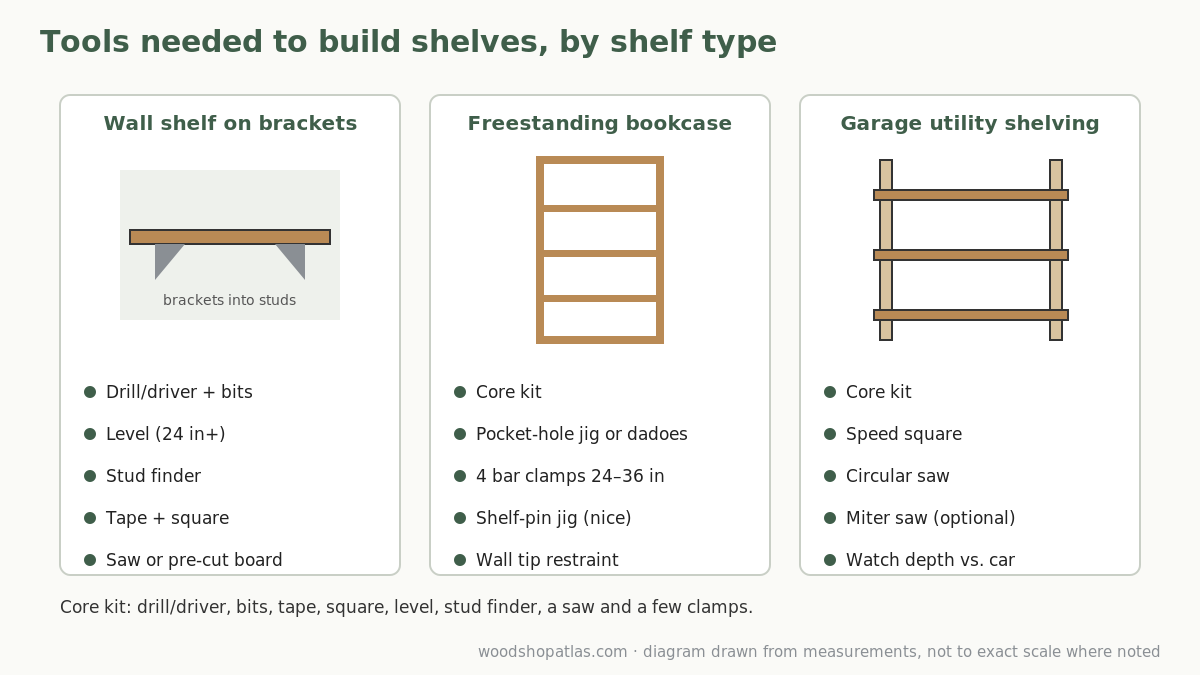
The tools needed to build shelves come down to a drill/driver, a tape measure, a level, a stud finder, a saw you can guide in a straight line (a circular saw with a straightedge is enough), two or more clamps and sandpaper. That basic kit handles wall shelves on brackets, simple bookcases and garage utility shelving. A pocket-hole jig is the most useful add-on for bookcases and cabinets, and a router is the upgrade when you want shelves set into grooves (dadoes) instead of screwed or pinned in.
The tool list depends a lot on which kind of shelf you’re building, so here it is by type.
The core kit for any shelf
| Tool | Why you need it | Notes |
|---|---|---|
| Drill/driver | Pilot holes, screws, shelf-pin holes | A cordless 18–20 V drill covers everything here |
| Drill bits + driver bits | Pilot holes sized to your screws, countersinks | A countersink bit makes screws sit flush |
| Tape measure + combination square | Layout, checking for square | The square matters more than people expect |
| Level (24 in / 61 cm or longer) | Level shelves and brackets | Longer levels average out bumps in the wall |
| Stud finder | Finding framing behind drywall | Confirm with a small nail or a magnet on the screws |
| Circular saw + straightedge or guide | Cutting boards and plywood to size | Or have the store cut sheet goods for you |
| 2–4 clamps | Holding a guide, gluing, holding parts square | Quick clamps are fine to start |
| Sandpaper or a random orbit sander | Edges and faces before finishing | 120 then 180 grit is plenty for paint |
If you already own a circular saw and a drill, most of this is the “next purchases” list in what to buy after a circular saw and drill.
Tools by shelf type
Wall shelves on brackets
The simplest shelf: a board on two or more metal brackets screwed to the wall.
- Must have: drill, level, stud finder, tape, saw (or a pre-cut board).
- Nice to have: a laser level if you’re hanging a row of shelves.
- Watch out for: fixings. Screw brackets into studs where you can. Where you can’t, use anchors rated for the load and follow the anchor maker’s instructions. Heavy books on a drywall-only fixing is the classic failure.
Floating shelves
These hide their support inside the shelf. Most people buy a floating-shelf bracket kit and build or buy a shelf to fit it.
- Must have: everything above, plus a drill bit long enough for the kit’s rods and a way to drill straight (a drilling guide helps).
- Watch out for: depth and load. A floating shelf puts leverage on its fixings, so stick to the kit’s stated depth and load limits.
A freestanding bookcase
Two sides, a top, a bottom, shelves and a back.
- Must have: core kit plus a pocket-hole jig or a way to cut dadoes (router or table saw), and enough clamps to hold a carcass square (four bar clamps of 24–36 in / 61–91 cm).
- Nice to have: a shelf-pin drilling jig for adjustable shelves. It turns a fussy layout job into a five-minute one.
- Watch out for: tipping. Tall bookcases should be anchored to the wall with a tip-restraint kit, especially in homes with children.
Garage or basement utility shelving
Usually 2×4 frames with plywood or OSB shelves.
- Must have: core kit, plus a speed square for marking 2x4s. A miter saw speeds things up if you’re cutting dozens of uprights, but a circular saw and square get it done.
- Watch out for: depth vs. the car. Shelving along a side wall eats into the space beside a parked car; see how deep a workbench (or shelf) can be and still park the car.
How to keep shelves from sagging
Sag is the most common shelf complaint, and it’s predictable. The free Sagulator calculator at WoodBin estimates it from material, span, depth and load. Its notes give a few useful anchors:
- A fully loaded bookshelf carries about 20–40 lb per running foot (9–18 kg per 30 cm).
- A sag of about 1/32 in per foot is visible; the Sagulator suggests designing for 0.02 in per foot or less, because wood shelves keep sagging about another 50% over time.
- Many bookshelves are 8–12 in (20–30 cm) deep, 24–36 in (61–91 cm) wide and 3/4–1 in (19–25 mm) thick.
And the rules of thumb that matter most when you’re choosing a design:
- Span is the big one. Doubling the span makes the sag eight times worse. Shortening it by a fifth roughly halves the sag.
- Thickness is next. Doubling the thickness cuts sag to one-eighth.
- Depth helps less. Doubling the depth halves the sag.
- An edge strip helps a lot. A solid-wood strip glued to the front edge stiffens a plywood or MDF shelf noticeably, and it hides the plywood edge too.
So if a 36-in shelf sags, the cheapest fix is often a center support or a stiffening strip, not a thicker shelf.
Plywood, MDF or solid wood?
| Material | Good for | Watch out for |
|---|---|---|
| Plywood (3/4 in) | Bookcases, garage shelves, painted or stained | Edges need banding or a strip to look finished |
| MDF | Painted shelves, smooth faces | Sags more than plywood; heavy; doesn’t like moisture |
| Solid wood boards | Wall shelves, rustic bookcases | Cupping on wide boards; costs more per foot of shelf |
| Melamine/particleboard | Closet and utility shelves | Sags the most; chips at cut edges |
What’s the right height for a shelf under a workbench?
A shelf under a bench is the best storage in a small shop, because it uses space you’d otherwise lose. Set it high enough to sweep under (Paul Sellers notes that his bench rails sit where they do partly so it’s easier to sweep under the bench, per his workbench FAQ), and low enough to leave room for whatever lives on it: a toolbox, a sander case, a bin of clamps. In practice that means measuring the tallest thing you want to store, adding a couple of inches for your hand, and working down from the underside of the benchtop.
For bench sizing itself, see how deep should a workbench be and how to choose workbench height, or run your numbers through the workbench height and depth calculator.
Buying material for shelves
Shelf material is sold two ways, and it helps to know which before you go to the store.
Plywood and MDF come in 4 x 8 ft (122 x 244 cm) sheets. Ripped lengthwise into four strips, a sheet gives four shelves just under 12 in (30 cm) deep and 8 ft long, once you allow about 1/8 in (3 mm) for each saw kerf. Cut those in half and you have eight 4-ft (122 cm) shelves. Many home centers will make the long rips for you on their panel saw, which also makes the sheet easier to get home.
Solid wood is sold by the piece at home centers (a 1×10 x 8 ft board, for example) and usually by the board foot at hardwood lumberyards. One board foot is 144 cubic inches: thickness x width x length in inches, divided by 144. A 1-in-thick, 8-in-wide, 8-ft board is 1 x 8 x 96 / 144, about 5.3 board feet. Our board-foot calculator does the arithmetic for any number of pieces of the same size, which makes pricing a bookcase’s parts quicker.
Remember that nominal sizes aren’t actual sizes: a “1×10” is about 3/4 x 9-1/4 in (19 x 235 mm), so check the real width against the shelf depth you planned.
What can wait
- A table saw. It makes shelf parts faster, but a guided circular saw (or the store’s panel saw) cuts plywood shelves fine. See track saw vs. table saw.
- A brad nailer. Handy for attaching backs and trim; not essential. Screws and glue work.
- A router. Worth it once you want dadoes, rounded edges or flush-trimmed edge banding. Not for your first shelf.
- A miter saw. Only if you’re cutting lots of 2x4s or trim.
A sensible first shelf project
If you’re building shelves to learn, a simple plywood bookcase with fixed shelves teaches the most for the least money: measuring, cutting sheet goods straight, assembling square, fixing to the wall and finishing. Do the cuts with a guided circular saw, join with pocket screws or screws and glue, and add a solid-wood strip to each shelf front.
New to the whole setup? See beginner woodworking tools for the full starter kit, and our Start Here page for the sequence.
FAQ
What tools do I need to build shelves?
A drill/driver with bits, a tape measure, a square, a level, a stud finder, a saw you can guide straight, a few clamps and sandpaper. Add a pocket-hole jig for bookcases.
Can I build shelves without a table saw?
Yes. A circular saw with a straightedge or guide cuts plywood shelves accurately, and many home centers will cut sheet goods to rough size for you.
How far can a shelf span without sagging?
It depends on material, thickness, depth and load. Use a calculator such as the WoodBin Sagulator and aim for 0.02 in of sag per foot or less. Doubling the span makes sag eight times worse, so shorter spans or a center support are the easiest fix.
What is the best wood for shelves?
3/4-in plywood is the best all-rounder for strength and cost. Solid wood looks best on wall shelves. MDF is good for painted shelves but sags more.
Do I need a stud finder to hang shelves?
It’s strongly recommended. Screwing brackets into studs is the most reliable fixing. Where there’s no stud, use anchors rated for the load.