
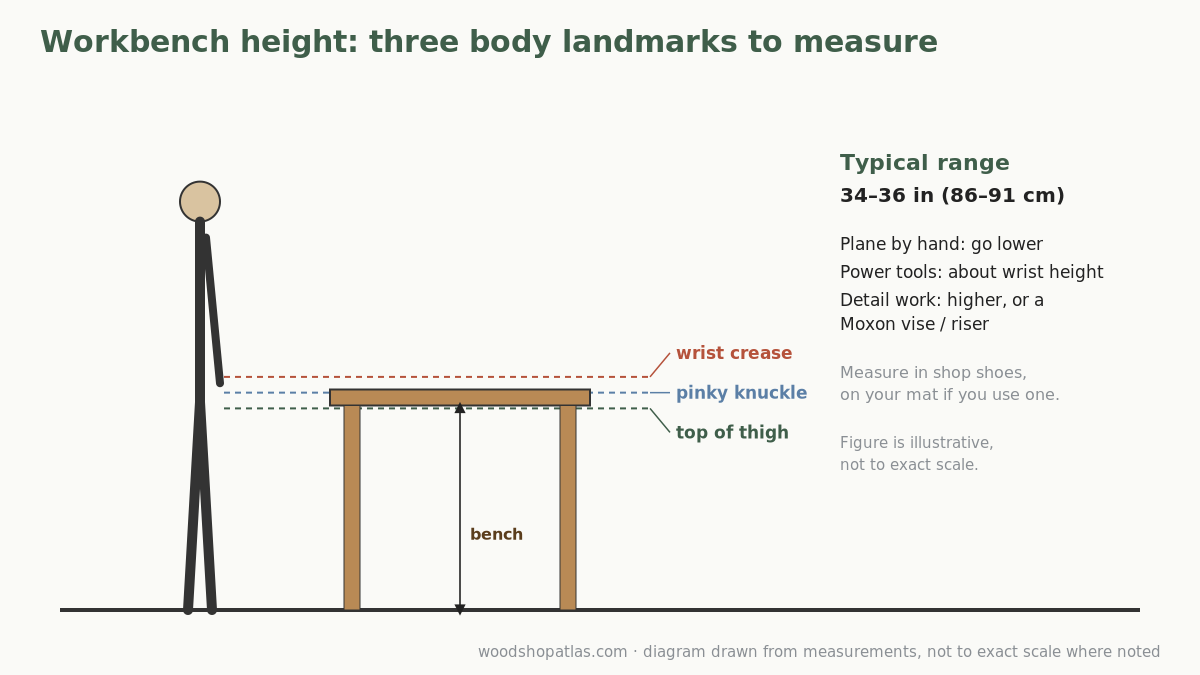
The standard workbench height is about 34 to 36 in (86–91 cm), and 36 in is the most commonly quoted number. But the right height for you depends on your height and your work. The quickest way to find it: stand straight, let your arms hang, and measure from the floor to your wrist crease or to the knuckle where your little finger meets your hand. Build there (or a little higher, if you mostly use power tools or do fine work) and adjust after a few sessions. Go a little lower if you plane a lot by hand.
Standard workbench heights, and who uses what
| Source | Height | Notes |
|---|---|---|
| Fine Woodworking (Christian Becksvoort) | “Standard benches are usually 36 in”; his own is 39 in | Rule of thumb: about wrist height (Fine Woodworking) |
| Paul Sellers | 38 in for a person of about 5 ft 10 in | Add or subtract by your height; start an inch high (Paul Sellers FAQ) |
| Christopher Schwarz | 34 in for himself at 6 ft 3 in; comfortable from 32 to 36 in | Prefers lower benches for hand planing (Lost Art Press, Popular Woodworking) |
| Kitchen counters | About 36 in | A familiar reference point, not a woodworking standard |
The spread is the point. Two experienced woodworkers of similar height can prefer benches 4 in apart, because one planes by hand and the other mostly uses routers and sanders.
Three body-based rules (pick one)
- Wrist crease. Stand straight, arms relaxed at your sides, and measure from the floor to the crease of your wrist. This is Fine Woodworking’s rule of thumb and a good all-round starting point.
- Pinky knuckle. Same stance; measure to where your little finger joins your hand. Schwarz describes this as his sweet spot. It comes out a little lower than the wrist rule, which suits hand planing.
- Top of the thigh. Schwarz also suggests “somewhere near the top of your thigh, maybe a little higher” as a good overall height for a tall bench.
Measure in the shoes you work in. If you’ll stand on an anti-fatigue mat, measure on the mat, because it raises you and makes the bench feel lower.
Adjust for the work you do
Hand planing: lower. Planing uses your legs and body weight, and a lower bench lets you get over the work. Schwarz lowered his bench from 36 to 34 in and found planing easier. Wooden-bodied planes sit taller than metal ones, so their users often go lower still.
Power tools and assembly: around the standard. Routing, drilling and sanding are comfortable near wrist height. For assembly, remember the workpiece adds height: a 30-in tall cabinet carcass on a 36-in bench puts the top edge at 66 in. Many people assemble on a lower table or on the floor for that reason.
Detail work, carving, joinery layout: higher. Becksvoort keeps a 12-in auxiliary bench that clamps to his main bench, bringing the surface to 51 in for carving. A Moxon-style vise that raises the work is the small-shop version of the same idea.
Outfeed support: match the saw. If the bench doubles as table saw outfeed, it should be at or just below the saw’s table height. Schwarz notes table saw tops are typically around 34 in, so a 34-in bench can double as outfeed. Check your own saw; jobsite saws on stands vary.
Sitting: if you do fine work seated, use a shop stool at your regular bench rather than building a second bench. Schwarz recommends sitting for detail work with carving tools, chisels or a router.
Things that change your bench height after you build it
- Casters add their own height, often several inches. Subtract them from the frame.
- A thicker top (laminating another layer) adds height.
- Mats raise you, effectively lowering the bench.
- An uneven garage floor can make one end higher. Shim the feet.
Fixing a bench that’s the wrong height
Too low: raise it with blocks or risers under the legs. Glue and screw hardwood blocks to the foot of each leg, or build a plinth. Becksvoort’s approach for occasional high work is a clamp-on auxiliary bench.
Too high: stand on a platform. Becksvoort keeps a 2-3/4 in platform under his 39-in bench and pulls it out for panel planing, effectively working at about 36-1/4 in. Or cut the legs, a little at a time. Sellers suggests building an inch high and trimming after you’ve worked at it.
Different tasks, different heights: use two surfaces. A main bench at your general height and a lower assembly table or a higher Moxon vise covers most needs without an adjustable bench.
Height-adjustable workbenches
Crank or electric lift benches let you change height for each task. They’re useful if several people of different heights share the bench, or for assembly-heavy work. They’re also more expensive, usually lighter and less rigid than a fixed bench of the same size, and Schwarz’s view is that adjusting your own height (stool or platform) is simpler. For most small shops, a fixed bench at the right height plus a platform or stool is the better value.
Worked example: two people, one garage
Say two people share a garage bench. One is 5 ft 4 in and mostly sands, routes and assembles small projects; the other is 6 ft 1 in and is getting into hand planes.
- Person A measures 31-1/2 in to the wrist crease in work shoes. A bench at 32–33 in suits most of their work, and a stool covers detail work.
- Person B measures 35 in to the pinky knuckle and 36-1/2 in to the wrist. For planing, 34–35 in will feel right; for routing, closer to 36–37 in.
One fixed bench can’t be perfect for both. A practical compromise: build at the taller person’s planing height (about 35 in), give the shorter person a sturdy 2–3 in platform to stand on, and use a Moxon vise or a clamp-on riser for detail work. That covers both people without an adjustable bench. (These measurements are an illustration, not data from real people; measure your own.)
Common mistakes
- Copying someone else’s number. A bench that’s perfect for a 6-ft woodworker who planes by hand can be wrong for a 5-ft-6 woodworker who mostly sands.
- Forgetting the casters or the mat. Both change the effective height by inches.
- Building to kitchen-counter height by default. 36 in is fine for many people, but it’s a starting point, not a rule.
- Cutting the legs short too soon. You can always cut more; you can’t add it back without blocks.
Workbench height and depth together
Height and depth interact: a deep bench at the wrong height makes the back of the bench hard to reach. If your bench sits against a wall, keep it to about 24 in (61 cm) deep, or 16–20 in (41–51 cm) if it shares a wall with a parked car. See how deep should a workbench be, and for bench types, folding vs. rolling vs. fixed workbenches.
A two-minute height test
- Put on your shop shoes and stand on whatever you’ll stand on.
- Measure floor to wrist crease and floor to pinky knuckle.
- Pick the wrist number if you mostly use power tools, the knuckle number if you plane by hand.
- If you already have a bench, try working with it raised on blocks or with you on a platform for one session each before cutting anything.
- Build or adjust, then live with it for a few weeks before you make it permanent.
If you’d rather plug in numbers, our workbench height and depth calculator takes your measured wrist height as the starting point (it deliberately doesn’t guess a height from your stature) and also works out how deep a bench can be behind a parked car. Treat the result the same way: a starting point to test, not a final number.
Planning the rest of the bench? The garage workbench guide covers length, placement, tops and storage. For the rest of the shop, start with one-car garage woodshop layouts or our Start Here page.
FAQ
What is the standard height of a workbench?
About 34–36 in (86–91 cm), with 36 in the most commonly quoted figure. Experienced woodworkers use anything from about 32 to 39 in depending on their height and work.
How tall should a workbench be for my height?
Measure from the floor to your wrist crease (or pinky knuckle) standing straight with arms relaxed. Paul Sellers’ benchmark is 38 in for someone about 5 ft 10 in, adjusted up or down by your height.
Is 36 inches a good workbench height?
For many people of average height doing mixed work, yes. Hand planers often prefer lower; people doing detailed work often prefer higher.
What height should a workbench be for hand planing?
Lower than your general bench height, often near the pinky-knuckle measurement or a little below, so your legs and body weight do the work.
Should a workbench be the same height as the table saw?
If it doubles as outfeed support, set it at or slightly below the saw table. Otherwise choose the height that suits your body and work.