
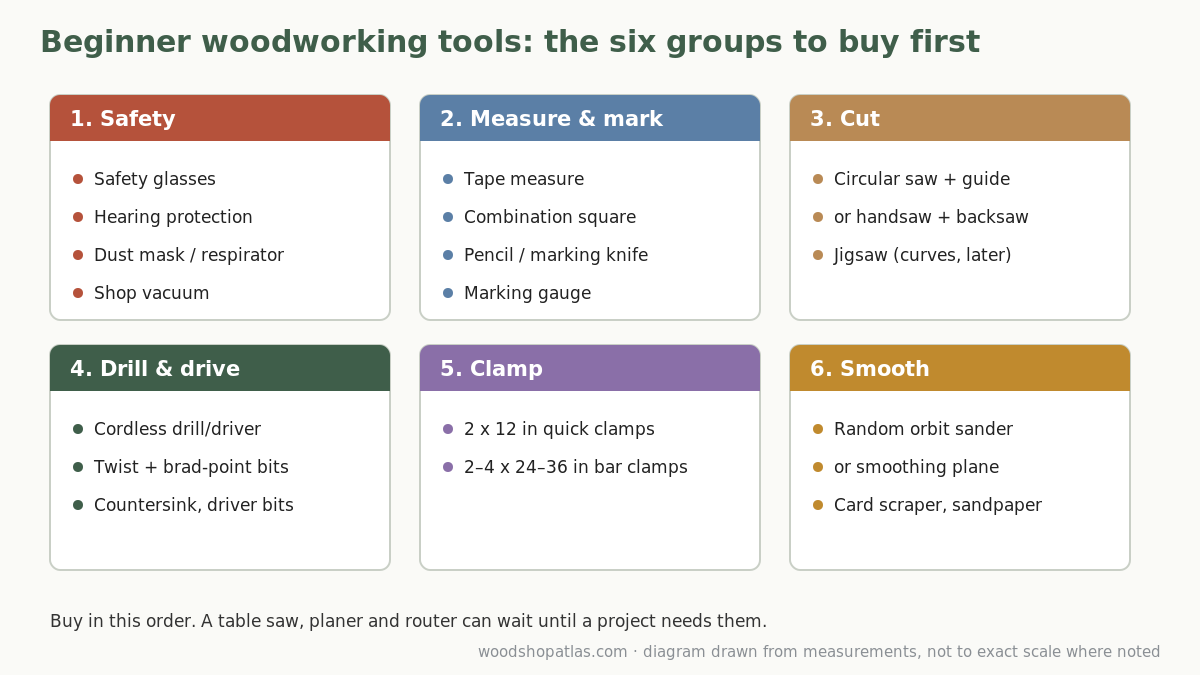
The beginner woodworking tools to buy first are, in this order: safety glasses, hearing protection and a dust mask; a tape measure, a combination square and a pencil or marking knife; one saw you can cut straight with (a circular saw with a guide, or a good handsaw); a drill/driver with bits; four or more clamps; and sandpaper or a random orbit sander. That kit builds shelves, boxes, simple tables and shop furniture. Everything else, including the table saw, can wait until a project you actually want to build needs it.
Below is the kit group by group, two ways to build it (mostly power tools or mostly hand tools), and what to skip.
The starter kit at a glance
| Group | Power-tool path | Hand-tool path | Why it’s first |
|---|---|---|---|
| Safety | Glasses, ear protection, dust mask or respirator | Glasses, dust mask | Non-negotiable with any saw or sander |
| Measuring and marking | Tape, combination square, pencil | Tape, combination square, marking knife, marking gauge | Accuracy starts here |
| Cutting | Circular saw + straightedge guide | Crosscut handsaw + backsaw (tenon saw) | Straight cuts make square projects |
| Drilling and driving | Cordless drill/driver, bits, countersink | Same (a drill is worth it on either path) | Holes and screws in almost every project |
| Clamping | 4+ bar or quick clamps | Same | Glue-ups and holding work |
| Smoothing | Random orbit sander + discs | Smoothing plane, card scraper, sandpaper | The difference between built and finished |
1. Safety gear
Buy it first and keep it where you’ll grab it without thinking.
- Eye protection: safety glasses rated for impact.
- Hearing protection: earmuffs or plugs. Circular saws, routers and shop vacuums are loud.
- Dust protection: a well-fitting dust mask or respirator for sanding and sawing. Wood dust isn’t just a nuisance: OSHA lists dermatitis, asthma and other respiratory effects among its health effects, and notes that some hardwoods, including oak, walnut, birch and beech, have been reported to cause nasal cancer in woodworkers, particularly at high exposures (OSHA).
- A shop vacuum belongs in this group too. Capturing dust at the tool is better than sweeping it later.
2. Measuring and marking
Paul Sellers, who teaches hand-tool woodworking, calls the square the tool he considers most important, because “all cuts and surfaces are proved by it” (Paul Sellers). A good combination square checks 90 and 45 degrees, measures depths and marks lines parallel to an edge.
- Tape measure: a 16–25 ft (5–7.5 m) tape.
- Combination square: 12 in (30 cm) is the most useful size.
- Pencil, or a marking knife for joinery. A knife line is finer and gives a saw or chisel a place to start.
- Marking gauge (hand-tool path): marks lines parallel to an edge for joints.
- Speed square (optional): fast for marking 2x4s and guiding a circular saw on short crosscuts.
3. One saw you can cut straight with
Power path: a circular saw plus a guide. A 7-1/4 in circular saw cuts plywood, boards and 2x4s. On its own it wanders; with a straightedge clamped to the work, or a commercial guide rail, it cuts accurately enough for furniture. This is the most flexible single saw for a beginner with little space.
Hand path: a handsaw and a backsaw. Sellers’ basic joinery kit includes a tenon saw, and his shaping and general list adds a handsaw (Paul Sellers). Japanese-style pull saws are a common alternative that many beginners find easy to start with.
Either path: a jigsaw is a useful second saw for curves and cutouts, but it isn’t a straight-cutting tool.
The table saw question comes up early. It’s the biggest space, safety and budget decision in a small shop, and it isn’t needed to start. See track saw vs. table saw for when it starts to make sense.
4. A drill/driver
A cordless drill/driver is worth owning on any path. Add:
- A set of twist bits and a set of brad-point bits for clean holes in wood
- A countersink bit, so screw heads sit flush
- A set of driver bits
An impact driver is handy for driving lots of long screws, but a drill/driver does the job for most beginner projects.
5. Clamps
You need more clamps than you expect. Four is the minimum to glue up a box or a small panel; six to eight is comfortable. Mix lengths:
- Two 12 in (30 cm) quick clamps for small work and holding guides
- Two to four 24–36 in (61–91 cm) bar clamps for glue-ups and carcasses
6. Sanding and smoothing
Power path: a 5 in random orbit sander with discs in 80, 120 and 180 grit covers most work.
Hand path: a smoothing plane and a card scraper. Sellers lists a smoothing plane in both his joinery and shaping kits and a scraper set among his shaping tools. A plane needs sharpening, so add a sharpening setup (Sellers’ list includes a whetstone and a strop).
A workbench, or something like one
You need a flat, solid surface at a comfortable height to hold work. It doesn’t have to be fancy: a pair of sawhorses with a sheet of plywood, a folding work table, or a simple bench you build as your first project. See folding vs. rolling vs. fixed workbenches and workbench height.
Power path or hand path?
| If you… | Lean toward |
|---|---|
| Want to build shelves, cabinets and shop furniture quickly | Power path |
| Have neighbors or family close by and work evenings | Hand path (much quieter) |
| Mostly use plywood and sheet goods | Power path |
| Want to learn joinery like dovetails and mortise-and-tenon | Hand path |
| Have very little space | Either; both fit on a wall and a shelf |
Most people end up with a mix: a circular saw and drill for breaking down material, and a few hand tools (a square, a chisel set, a block plane) for fitting and finishing.
New or used?
Hand tools are often good value secondhand. Sellers writes that he buys many of his tools used, from eBay, garage sales and flea markets, and that an older plane or saw can serve for decades once it’s sharpened and set up (Paul Sellers). Squares, planes, saws, chisels and clamps are good used buys if they aren’t cracked, bent or badly rusted.
Power tools are more of a judgment call. Check that cordless tools come with working batteries (or that you already own the same battery platform), that cords and plugs aren’t damaged, and that guards and safety parts are present. When in doubt, a new budget tool with a warranty is the safer first purchase.
What can wait
- A table saw, bandsaw or jointer. Big, expensive and space-hungry. Buy them when a project needs them.
- A thickness planer. Only needed if you buy rough lumber. See planer stand options if you get there.
- A router. Excellent for edges, grooves and joinery, but not a first-week tool.
- Large kits and sets. Big chisel and bit sets often include sizes you’ll never use. Buy the sizes your projects call for.
Already own a circular saw and a drill? Skip to what to buy after a circular saw and drill.
Where to keep a beginner kit
A starter kit fits in very little space: a wall with a pegboard or French cleat for hand tools, one shelf or a rolling cart for the power tools and their cases, and a hook or two for clamps. Keep safety gear by the door so it’s the first thing you pick up. If you share a garage with a car, our garage workbench guide shows how to fit a bench and storage beside it.
Good first projects for this kit
- A pair of sawhorses or a simple work table: teaches measuring, cutting and screwing, and you’ll use them forever.
- A wall shelf or a simple plywood bookcase: straight cuts, square assembly, finishing. See tools needed to build shelves.
- A box with glued corners: clamping, squaring and sanding.
If you’re buying solid wood, our board-foot calculator helps with pricing, and our Start Here page lays out the order for setting up the rest of the shop.
FAQ
What tools does a beginner woodworker need?
Safety glasses, hearing protection and a dust mask; a tape measure and combination square; one saw you can cut straight with (a circular saw with a guide, or a handsaw); a drill/driver; at least four clamps; and sandpaper or a random orbit sander.
What is the first power tool to buy for woodworking?
For most people, a cordless drill/driver, followed closely by a circular saw with a straightedge guide. Together they cut and assemble most beginner projects.
Do I need a table saw to start woodworking?
No. A guided circular saw or a handsaw handles the cuts in most beginner projects. A table saw becomes useful when you need many precise, repeated rips.
Should I start with hand tools or power tools?
Either works. Power tools are faster for sheet goods and shop furniture; hand tools are quieter, cheaper to start and better for learning joinery. Many people use both.
Are woodworking tool starter kits worth it?
Sometimes, but check the contents. Kits often include sizes and accessories you won’t use. Buying the specific tools your first projects need is usually better value.