
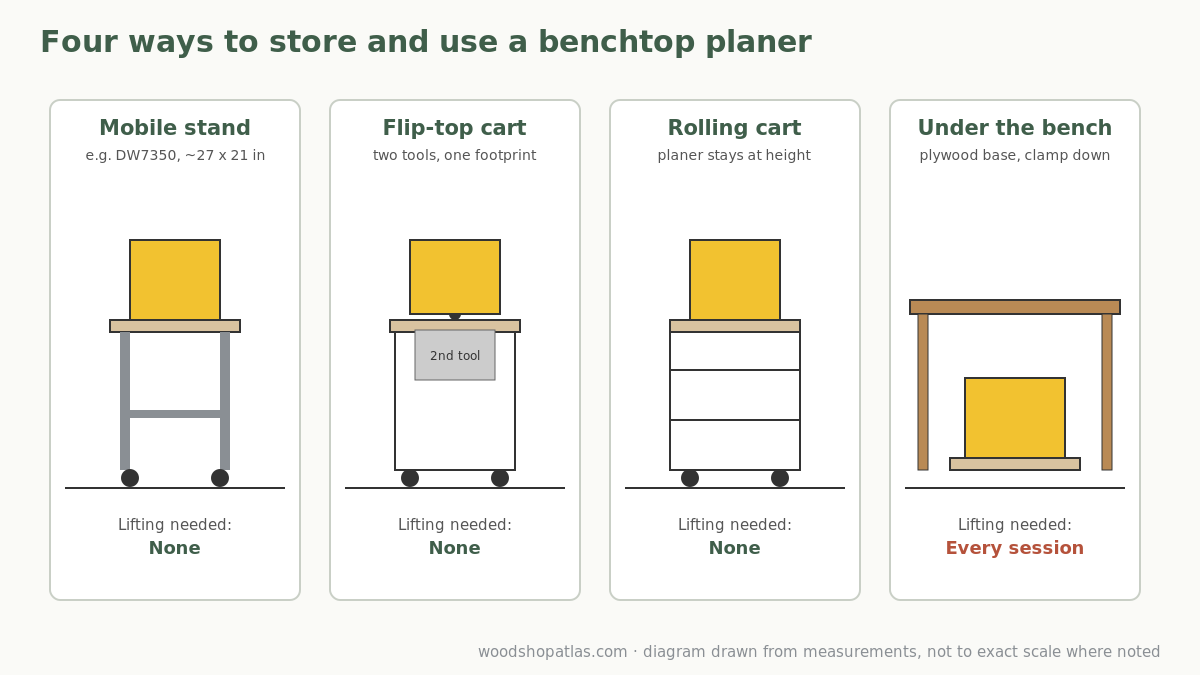
For most small shops the best planer stand is a mobile one at a height where you never lift the planer: either a dedicated mobile stand like DeWalt’s DW7350, or a flip-top cart if you want the same footprint to double as a second tool stand or work surface. Storing the planer under a workbench on a low cart is the cheapest option and works if you plane occasionally. Lifting a benchtop planer onto a bench each session is the option to avoid: the popular DeWalt DW735 weighs about 92 lb (42 kg).
The four options at a glance
| Option | Floor footprint | Lifting needed | Extra use | Best for |
|---|---|---|---|---|
| Mobile planer stand (e.g. DeWalt DW7350) | About 27 x 21 in (69 x 53 cm) for the DW7350 | None once mounted | Shelf underneath | Planing often; dedicated corner |
| Flip-top cart | Usually a bit bigger than the planer’s longest side | None | Second tool on the other face, or a flat work surface | Small shops that want two tools in one footprint |
| Rolling cart (fixed top) | Planer footprint plus a margin | None | Storage below | Simple build; planer stays at working height |
| Plywood base, stored under a bench | Under-bench space only | Yes, every session | Bench space when stored | Occasional planing |
Mobile planer stands
A purpose-built stand puts the planer at a fixed height, adds wheels and gets out of the way. DeWalt’s DW7350 is the reference example:
- Fits the DeWalt DW733, DW734 and DW735; the manual rates the stand to 300 lb (136 kg) (DeWalt DW7350 manual).
- A foot pedal raises it onto its wheels to roll and lowers it onto its feet to work.
- Retailers list it at about 27 x 21 in (69 x 53 cm), about 29-1/2 to 30 in (75–76 cm) to the work surface, and 55–57 lb (25–26 kg).
The manual’s warnings are worth reading before you buy: lower it onto its feet before planing, and be careful rolling it, because the stand can tip if a wheel stops suddenly. With a 92-lb planer on top, the center of gravity is high.
Universal rolling stands are the other route. DeWalt’s DWX726 rolling miter saw stand is rated for 300 lb, folds to about 59-1/2 x 17 in (151 x 43 cm), and DeWalt explains how to mount a DW734 or DW735 planer on its rails, with the planer’s rollers parallel to the stand’s (DeWalt support, DeWalt DWX726). That’s a good choice if you already own or want a miter saw stand and can live with swapping tools.
For full DW735 and DW7350 dimensions, including where the sources disagree, see DeWalt DW735 dimensions, weight and storage footprint.
Flip-top carts
A flip-top cart is a box on casters with a top that rotates on a pivot. One tool is bolted to each face (planer on one side, a spindle sander or a flat top on the other), and you flip the top to swap. It’s popular in small shops because one footprint holds two tools, and the tool is always at a fixed working height.
What to check before you build or buy one:
- Clearance inside the box. The planer has to swing through the cabinet. The interior must be deeper than the planer is tall, plus clearance for the crank handle and dust port. The DW735 is about 18–19 in tall bare and the DW735X is listed at about 21-3/4 in with its tables folded, so the cabinet interior must comfortably exceed whichever you own.
- Balance. The planer is heavy and off-center. Pivot position, a solid lock in both positions and controlled rotation matter more than anything else. Follow the plan or manufacturer’s design closely; this is not the place to improvise.
- Pinch points. The rotating top can trap fingers. Keep hands clear and lock it before letting go.
- Working height. Decide whether the planer bed should match your bench or saw for outfeed support.
We’re not publishing a flip-top design here. Use a tested plan from a reputable source and follow its hardware and assembly instructions.
Rolling carts with a fixed top
The simplest dedicated home for a planer: a sturdy cart at a convenient height with the planer bolted on top and storage underneath. It’s less clever than a flip-top but has fewer things to go wrong.
Make it wide and heavy at the bottom, use locking casters (ideally locking both the wheel and the swivel), and keep heavy things on the lowest shelf. Size the top to the planer’s base plus a few inches each side.
Under-bench storage on a plywood base
DeWalt’s DW735 manual describes mounting the planer to a piece of 1/2 in (12.7 mm) or thicker plywood for portability, and says to always mount it firmly (DW735 manual). The base can then be clamped to a bench in use and stored underneath the rest of the time.
Will a planer fit under a workbench? A typical 36-in (91 cm) bench with a 1-3/4 in (4.5 cm) top leaves about 34 in (86 cm) underneath, minus any stretcher or shelf. A DW735 at 18–22 in tall leaves room for a low cart of 10–12 in (25–30 cm). Use that cart. Lifting 92 lb from floor level to a bench is exactly the kind of lift that hurts backs.
How much room a planer needs while it’s running
Whatever the stand, the planer needs a feed lane: the board’s length in front and behind, plus a bit. DeWalt’s manual says to locate the planer with proper clearance on the outfeed side so the board can’t bind against an obstacle. In a garage that still parks a car, that usually means:
- Car out.
- Planer rolled to the middle of the bay, aligned with the garage’s long axis.
- Outfeed support (a roller stand or a bench at matching height) for anything over about 4 ft (1.2 m).
For a 6-ft (183 cm) board, plan on a lane of about 14–15 ft (4.3–4.6 m) including the planer. See portable vs. stationary tools for a shared garage for how this lane competes with the table saw’s.
Dust: plan for it with the stand
A planer produces more chips per minute than any other common small-shop tool. DeWalt’s DW735 manual doesn’t recommend connecting a shop vacuum, because most can’t keep up and the hose may clog. If your stand or cart has room, plan space for a chip separator or a small dust collector beside it. If not, put a chip bag or bin where the chips go and sweep after each session. Our 10-minute workshop reset covers the cleanup routine.
Setting the stand height
A planer stand has one job beyond holding the machine: putting the bed at a height where you can feed boards comfortably and catch them on the far side. A few things to weigh:
- Feeding: the planer bed somewhere around your workbench height is comfortable for most people, because you’re pushing boards in a straight line, not leaning over them. Measuring your wrist height (the same starting point our workbench height and depth calculator uses for benches) gives a body-based reference.
- Outfeed: if the bench or a roller stand catches boards on the outfeed side, the stand should put the planer bed at or just above that surface, so boards don’t dip as they leave.
- The DW7350: its work surface sits around 29-1/2 to 30 in (75–76 cm) per retailer listings, and the planer adds its own bed height on top. Measure your own setup rather than assuming.
- Casters: they add height. If you build your own cart, include them in the math.
Before you pick a spot for it, measure both footprints (see how to measure equipment) and check that the feed lane fits beside everything else with our garage workshop planner, especially if you share the garage with a car.
Choosing: a quick guide
- You plane every week: a mobile stand or a rolling cart at working height.
- Floor space is tight and you have a second benchtop tool: a flip-top cart, built from a tested plan.
- You plane a few times a year: plywood base, under-bench storage on a low cart, clamped to the bench when needed.
- You already have a universal miter saw stand: check whether your planer can mount on its rails.
If you’re still deciding whether you need a planer at all, the short answer is: only if you buy rough or uneven lumber. See what to buy after a circular saw and drill.
FAQ
What is the best stand for a benchtop planer?
One that keeps it at working height and moves on wheels, so you never lift the planer. For DeWalt planers, the DW7350 mobile stand is designed for the DW733, DW734 and DW735.
What is a flip-top tool stand?
A cart with a rotating top that carries a tool on each face. You flip it to switch tools, so two benchtop tools share one footprint.
Can I store a planer under my workbench?
Usually yes if you store it on a low cart. Under a 36-in bench there’s often about 34 in of height, and most benchtop planers are 18–22 in tall.
How high should a planer stand be?
High enough that feeding boards is comfortable and the planer bed lines up with any outfeed support you use. Many people match their workbench or table saw height.
Do I need a planer stand with wheels?
In a shared or small shop, yes. You’ll need to roll the planer into an open lane to feed long boards and roll it back afterwards.