
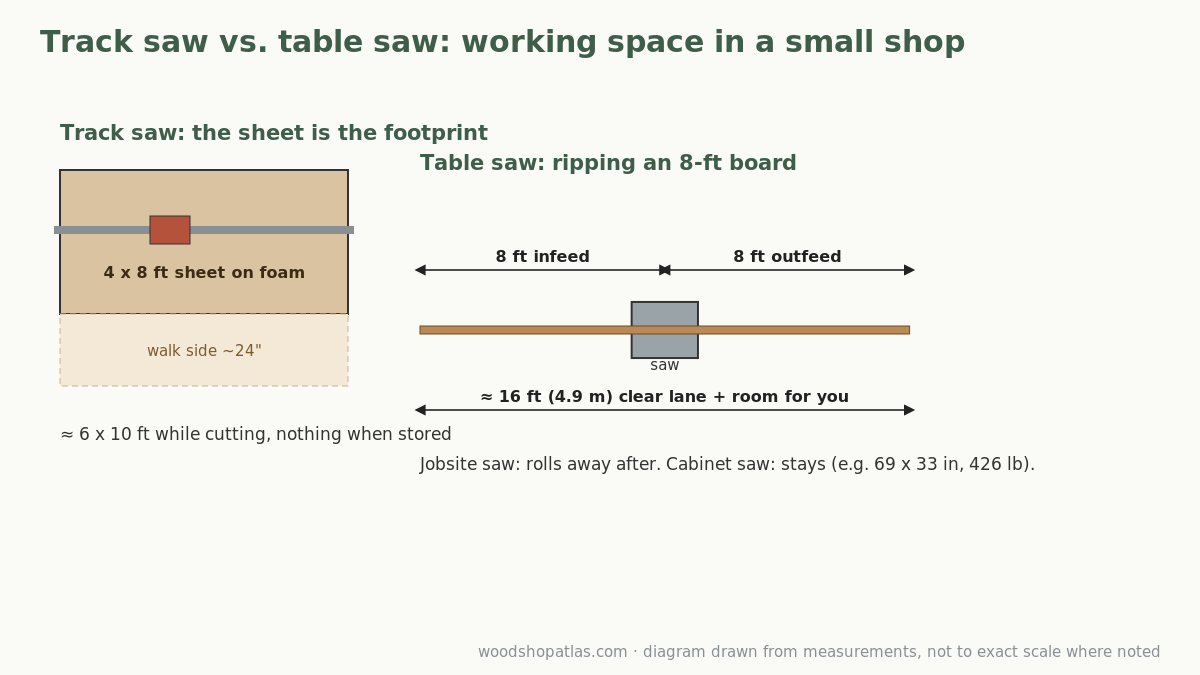
For a small or shared workshop, buy a track saw first if most of your work is plywood and sheet goods (cabinets, shelves, built-ins), because it cuts full sheets where they lie and stores in a box. Buy a table saw first if you make lots of narrow, repeated rips and small parts from solid wood (boxes, frames, furniture), and you have about 16 ft (4.9 m) of clear length to feed an 8-ft board. Many woodworkers end up with both: the track saw breaks sheets down, the table saw does the precise follow-up cuts.
Below are the real dimensions, the cuts each one handles badly, and a decision table.
The specs side by side
Representative models, from manufacturer pages and manuals:
| Festool TS 55 (track saw) | DeWalt DCS520 (cordless track saw) | DeWalt DWE7491RS (jobsite table saw) | SawStop PCS, 3 HP, 36 in fence (cabinet saw) | |
|---|---|---|---|---|
| Max depth of cut at 90° | 2-1/8 in (55 mm) | 2-1/8 in (54 mm) | 3-1/8 in (79 mm) | n/a here |
| Rip / cut length | Rail-limited: FS 1400 rail is 55 in (1,400 mm); rails up to 118 in (3,000 mm) | 59 in (150 cm) and 102 in (259 cm) tracks | 32-1/2 in (83 cm) to the right of the blade | 36 in (91 cm) |
| Footprint in use | The workpiece | The workpiece | Table 21-7/8 x 26-3/8 in (56 x 67 cm), plus infeed/outfeed | 69-1/8 x 33 in (176 x 84 cm) |
| Weight | About 10 lb (4.5–4.8 kg) | Saw only, battery adds | Over 55 lb (25 kg) saw only; stand adds more | 426 lb (193 kg) assembled |
| Power | 120 V, 1,200 W | 60 V battery | 120 V, 15 A | 230 V, 13 A (NEMA 6-15 plug) |
Sources: Festool TS 55 FEQ-F-Plus and FS 1400/2 rail; DeWalt 102-in track; DeWalt DWE7491 manual; SawStop PCS. Checked 13 Nov 2026.
A note on rails: Festool says the 55-in FS 1400 rail makes cuts up to 49 in (124 cm) long, just enough to cross-cut a 48-in-wide sheet. At least one retailer lists the same rail at a 41-in cut length. If crosscutting full sheets is the point, check with your dealer or go one rail size up.
What a track saw does better
- Breaking down full sheets. You lay the rail on the cut line and push the saw. A 4 x 8 ft (122 x 244 cm) sheet of 3/4-in plywood weighs a lot, and you never have to lift it onto a saw table.
- Clean edges on veneered plywood. Track saws use a splinter strip on the rail that supports the fibers right at the cut line, so both sides come out cleaner than with a regular circular saw.
- Angled and tapered cuts on big panels. Cutting a long taper or a bevel on a 6-ft panel is awkward on a table saw and simple with a rail.
- Storage. A track saw lives in a case on a shelf. The rails hang on a wall. In a garage that parks a car, that matters more than anything on the spec sheet.
- Working anywhere. The driveway, a spare room, on top of sheets of rigid foam insulation on the floor.
What a table saw does better
- Narrow, repeated rips. Twenty pieces at exactly 2-1/4 in (57 mm) wide is a fence setting and twenty pushes on a table saw. With a track saw, each cut means re-placing the rail, and narrow offcuts don’t support the rail well.
- Small parts. Box sides, drawer parts and trim strips are easier and more consistent on a table saw (using push blocks and sleds).
- Joinery cuts. Dadoes, rabbets, grooves, tenons and box joints are all classic table saw operations. A track saw can do some of these, usually more slowly.
- Speed for batch work. Once the fence is set, cuts are fast and identical.
- Depth. 3-1/8 in (79 mm) on a 10-in jobsite saw vs. about 2-1/8 in on a typical track saw.
How much space each one needs
This is the deciding factor in most small shops.
Table saw: to rip a board, you need the board’s length in front of the blade and roughly its length behind it. An 8-ft (244 cm) board needs a clear lane of about 16 ft (4.9 m) plus the saw and you. Crosscutting a wide panel on the table saw also needs room to the left. A jobsite saw can roll into that lane and back out again, but the lane still has to exist while you cut. Working with a 12 x 20 ft (3.7 x 6.1 m) one-car garage, that usually means the car is outside.
Track saw: it needs the workpiece plus room to walk along it. A full sheet on the floor or on sawhorses takes about 4 x 8 ft, and you need roughly 2 ft (61 cm) on the side you walk. Call it 6 x 10 ft (1.8 x 3 m) while you cut, and nothing when you’re done.
Cabinet saw: the SawStop PCS above is 69-1/8 x 33 in (176 x 84 cm) with its 36-in fence, weighs 426 lb (193 kg) and the 3 HP version needs a 230 V circuit. That’s a permanent machine. Mobile bases help, but it won’t share a parking bay gracefully. To see whether a saw lane fits your own garage, try the garage workshop planner or the measured plans in one-car garage woodshop layouts. For more on this trade-off, see portable vs. stationary tools for a shared garage.
Can a track saw replace a table saw?
For a lot of people, yes. If you build cabinets, shelves, built-ins and plywood furniture, a track saw with one long and one short rail covers almost every cut. Add parallel guides (sold by several brands) and repeated rips get much easier.
Where a track saw falls short is narrow strips, small parts and joinery. If your projects are mostly solid-wood boxes, frames and chairs, a table saw is the more useful tool. Some woodworkers bridge the gap with a router for joinery and a bandsaw for small parts, but that’s more tools, not fewer.
Track saw vs. table saw for cabinet making
Cabinets are mostly plywood panels, so the track saw has the edge for the first cuts. The typical workflow in shops that own both:
- Break down the full sheets with the track saw into oversize parts.
- Trim parts to final width on the table saw, using the fence for repeatable sizes.
- Cut dadoes and rabbets on the table saw or with a router.
With only a track saw, step 2 happens with the rail and a pair of parallel guides or a stop. It’s slower, but it works.
Safety, briefly
Both tools can hurt you. A table saw’s main hazards are kickback and hands near an exposed blade; use the riving knife, blade guard and push sticks, and read the manual’s kickback section. Track saws plunge into the cut with the blade enclosed and most include a riving knife, but they can still kick back if the rail moves or the cut binds. Follow the manufacturer’s instructions for each saw, and don’t take shortcuts with either.
Price check
Prices change often, so treat these as a snapshot from 13 Nov 2026:
- Festool TS 55 F kit with 55-in rail (577014): $818 at one Festool dealer (Hartville Hardware).
- DeWalt DWE7491RS with rolling stand: $699 at one retailer (WebstaurantStore).
- SawStop Professional Cabinet Saw: from $3,881 (SawStop).
Budget track saws and a guided circular saw cost much less. If you already own a circular saw, a track-style guide for it is a cheap way to test whether you like rail-guided cutting. We cover that in what to buy after a circular saw and drill.
Which to buy first
| Your situation | Buy first |
|---|---|
| Shared garage, car parks inside | Track saw (or a guide for your circular saw) |
| Mostly plywood: cabinets, shelves, built-ins | Track saw |
| Mostly solid wood: boxes, frames, furniture parts | Table saw |
| You need lots of identical narrow strips | Table saw |
| You work in the driveway or move between sites | Track saw |
| Dedicated shop with a 16 ft clear lane | Either; table saw if your projects are joinery-heavy |
| You already own a jobsite table saw | Add a track saw or guided circular saw for full sheets rather than wrestling them onto the saw |
For the DeWalt DWE7491RS used as the example here, see its folded and set-up dimensions. If you still haven’t decided where things will go, how to plan a woodshop in a garage that still parks a car walks through the measuring, and our Start Here page has the overall order.
FAQ
Is a track saw better than a table saw?
It’s better for breaking down plywood and sheet goods and for small spaces. A table saw is better for narrow repeated rips, small parts and joinery. Neither is better for everything.
Can a track saw replace a table saw?
For plywood-based work like cabinets and shelves, largely yes, especially with parallel guides. For small parts and joinery-heavy solid wood work, not really.
Should I buy a track saw or a table saw first?
Track saw if you work in a shared or small space or mostly with sheet goods. Table saw if you have a dedicated shop with room to feed long boards and mostly build from solid wood.
Is a track saw safer than a table saw?
The blade is more enclosed and your hands are further from it, which many people find less intimidating. Both can kick back. Follow each manufacturer’s safety instructions.
Track saw vs. table saw vs. circular saw: what’s the difference?
A circular saw is the basic handheld saw. A track saw is a circular saw built to run on a rail, with a plunge action and splinter control. A table saw is a stationary blade you push the wood through. A circular saw on a good guide gets you part of the way to a track saw for much less money.