
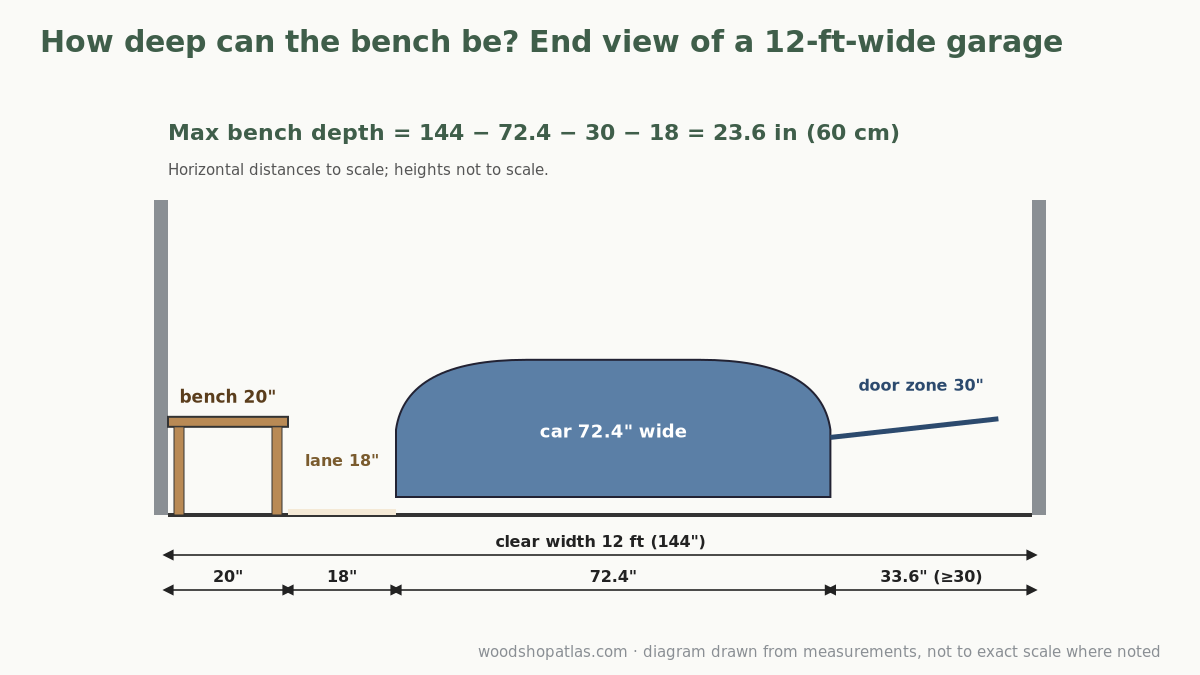
A workbench should be about 24 in (61 cm) deep for general woodworking. That’s deep enough to hold half a sheet of plywood and shallow enough that most people can reach the back edge without leaning over. In a garage that still parks a car, 16 to 20 in (41–51 cm) is often the most you can fit, and it’s still a perfectly usable bench. Going past 30 in (76 cm) on a wall-mounted bench mostly creates a shelf you can’t reach.
Below: why 24 in works, when to go shallower or deeper, and a fit formula for garages.
Why 24 inches is the default
Three things point to roughly 2 ft:
- Reach. Standing at the front edge, most adults can comfortably reach about 24 in forward without stretching. Past that, you’re leaning on the bench to get to the back, which is fine for a moment and tiring for a project.
- Materials. A 4 x 8 ft sheet of plywood ripped in half gives two 24 x 96 in (61 x 244 cm) pieces. A 24-in-deep bench supports those fully, and cabinet sides and shelves for most furniture fall under that width.
- Familiar standards. Kitchen base cabinets are built about 24 in deep, so countertops, base cabinets and their drawer hardware all exist at that size. A bench built on that module can reuse cabinet parts.
Paul Sellers, who has taught woodworking for decades, describes the benches his schools use as around 2 ft x 5–6 ft long and 38 in tall, and says that size works for a confined area (Paul Sellers, “On sizing your workbench”).
Workbench depth by use
| Depth | Works well for | Trade-off |
|---|---|---|
| 12–15 in (30–38 cm) | Wall-hung tool station, sharpening, vise-only bench, a narrow bench in a crowded garage | Too shallow for assembly; parts hang off the edge |
| 16–20 in (41–51 cm) | Garage bench beside a car, hand-tool work, small-parts assembly, a benchtop tool station | Wider parts need support from a second surface |
| 22–24 in (56–61 cm) | General woodworking; the default | Takes real floor space in a one-car garage |
| 25–30 in (64–76 cm) | Freestanding benches you can work around; large assembly | Hard to reach the back when it’s against a wall |
| 30–36 in (76–91 cm) | Freestanding assembly or outfeed tables | Too deep for a wall bench |
Two details change the numbers:
- Against a wall vs. freestanding. A freestanding bench can be deeper, because you can walk around and reach from the other side. Against a wall, stick close to your reach.
- Wall storage above. If you’ll hang tools on the wall behind the bench, a shallower bench (18–22 in) keeps them within reach.
How deep can a garage workbench be and still park a car?
Use the garage’s clear width and a few clearances:
Maximum bench depth = clear garage width − car width − driver’s door zone − walk lane
- Car width: from the manufacturer spec, plus mirrors if they don’t fold.
- Driver’s door zone: 30 in (76 cm) is tight, 36 in (91 cm) is comfortable. Builder Tim Carter notes that about 30 in from car to drywall often isn’t enough to open a door fully, and that his family’s Volvo XC90 needs 36 in (Ask the Builder).
- Walk lane on the bench side: about 18 in (46 cm) to get past the car and stand at the bench.
Here’s what that gives for three common vehicles (widths without mirrors, 30-in door zone, 18-in lane):
| Clear garage width | Toyota Camry (72.4 in / 184 cm) | Honda CR-V (73.5 in / 187 cm) | Ford F-150 SuperCrew (79.9 in / 203 cm) |
|---|---|---|---|
| 11 ft 6 in (138 in / 351 cm) | 17.6 in (45 cm) | 16.5 in (42 cm) | 10.1 in (26 cm) |
| 12 ft (144 in / 366 cm) | 23.6 in (60 cm) | 22.5 in (57 cm) | 16.1 in (41 cm) |
| 13 ft (156 in / 396 cm) | 35.6 in (90 cm)* | 34.5 in (88 cm)* | 28.1 in (71 cm)* |
| 14 ft (168 in / 427 cm) | 47.6 in (121 cm)* | 46.5 in (118 cm)* | 40.1 in (102 cm)* |
*More space than a wall bench should use. Cap the bench at 24 in and keep the rest as a wider walkway or for a rolling cart.
Vehicle widths come from the Toyota 2025 Camry brochure, Honda’s 2025 CR-V specifications and Edmunds’ 2025 F-150 SuperCrew specs. Your garage’s “12 ft” is almost certainly less once you measure drywall to drywall, which is why the first row is there.
If someone regularly gets out on the bench side too, replace the 18-in lane with a second door zone. In a 12-ft garage that usually leaves too little for a side bench, and the bench moves to the front wall or becomes a fold-down. We cover those layouts in how to plan a woodshop in a garage that still parks a car.
How tall should a workbench be?
Height matters as much as depth, and the two interact. A deeper bench feels harder to reach if it’s also too high.
- Common standard: 36 in (91 cm). Fine Woodworking’s rule of thumb is a bench that comes up to about your wrist with your arms hanging, noting most benches are around 36 in (Fine Woodworking).
- Typical range: about 34–38 in (86–97 cm) for most adults. Sellers’ school benches are 38 in.
- Lower for planing, because you push down and forward. Higher for detail work, carving and sawing joinery.
- Match your saw if the bench doubles as outfeed support. Then a fraction of an inch below the saw table is better than above it.
To find yours: stand straight in work shoes, let your arms hang, and measure from the floor to the crease of your wrist. Start there and adjust after a few projects. Raising a bench with blocks under the legs is easy; lowering one means cutting legs. Our full guide to workbench height covers the other body-based rules and task adjustments, and the workbench height and depth calculator works out how deep a bench can be behind the car from your own measurements.
How long should a workbench be?
Length is the easiest dimension, because it’s usually set by the wall:
- 4 ft (122 cm): the practical minimum for a full workbench. Fits a vise and a small project.
- 5–6 ft (152–183 cm): the sweet spot. Long enough for most furniture parts and a vise at one end, and Sellers suggests 5–6 ft “should be adequate for anyone.”
- 8 ft (244 cm): useful if you work with long boards, but in a small garage it often blocks a door, a window or the electrical panel.
In a shared garage, a 6-ft bench plus a rolling cart beats an 8-ft bench almost every time. The cart extends the bench when you need length and moves out of the way when you don’t.
Garage workbench dimensions at a glance
| Situation | Depth | Height | Length |
|---|---|---|---|
| Beside a parked car (12 ft garage) | 16–20 in (41–51 cm) | 34–38 in (86–97 cm) | 5–6 ft (152–183 cm) |
| Dedicated one-car shop, wall bench | 22–24 in (56–61 cm) | 34–38 in | 6–8 ft (183–244 cm) |
| Freestanding / rolling bench | 24–30 in (61–76 cm) | Saw height if used for outfeed | 4–6 ft (122–183 cm) |
| Tool station or sharpening bench | 12–18 in (30–46 cm) | 36–40 in (91–102 cm) | 3–4 ft (91–122 cm) |
What about a tool well?
A tool well is a recessed tray along the back of a bench where tools rest without rolling onto the work. It adds depth without adding usable worksurface, so on a shallow garage bench it’s usually better left out. Put the tools on the wall instead, where they don’t take any of your precious 18 or 20 inches.
Before you build: tape it out
The cheapest test in woodworking: put masking tape on the floor where the bench will go, at the depth you’ve calculated, and live with it for a week. Park the car against the tape. Walk past it carrying groceries. Open the doors. If the tape bench gets in the way, the real one will too.
Our garage workshop planner lets you lay those numbers out to scale with your car before you tape anything. Then decide what kind of bench to build (our garage workbench guide covers types, tops and placement). A fixed bench, a rolling bench or a folding one each suit different garages; see folding vs. rolling vs. fixed workbenches. And if you haven’t settled which tools that bench needs to support, what to buy after a circular saw and drill is a good next read, along with our Start Here guide.
FAQ
What is the standard depth of a workbench?
About 24 in (61 cm). It matches kitchen base cabinets, supports half a sheet of plywood and stays within most people’s reach.
How deep should a garage workbench be?
In a dedicated garage shop, 22–24 in. Beside a parked car, usually 16–20 in. Work it out from your garage’s clear width minus the car, a 30–36 in door zone and an 18-in walk lane.
Is 30 inches too deep for a workbench?
Against a wall, usually yes, because you can’t comfortably reach the back. For a freestanding bench you can walk around, 30 in works well.
How wide should a workbench be?
“Width” usually means length along the wall. 5–6 ft is a good target; 4 ft is the practical minimum for a full bench.
What is a good workbench height and depth for a small shop?
Start with your wrist height (often 34–38 in) and a 24-in depth, or 16–20 in if the bench shares a wall with a parked car.
How deep should a workbench be in cm?
About 60 cm for a general bench, 40–50 cm beside a car, and no more than about 75 cm against a wall.