
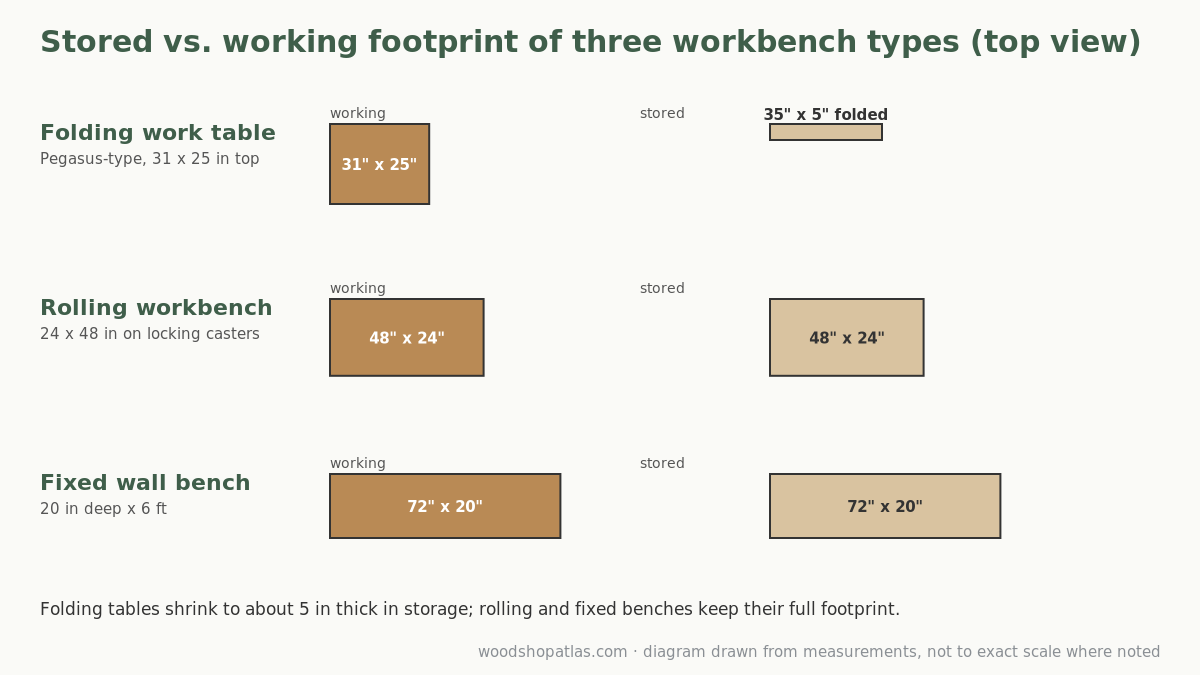
For most small garages the answer is a narrow fixed bench on one wall plus one rolling cart, with a folding table as a backup surface for big jobs. If you can’t spare any wall at all (the car takes the full width) a rolling bench is the better single choice. A folding bench alone works for occasional projects, light assembly and cutting sheet goods with a circular saw, but it isn’t a substitute for a heavy surface when you’re chiseling, planing or using a vise.
Here’s the reasoning, with real dimensions.
The three types in one table
| Folding bench / work table | Rolling (mobile) bench | Fixed bench | |
|---|---|---|---|
| Stored footprint | 4–5 in (10–13 cm) thick against a wall | Same as working footprint | Same as working footprint |
| Typical top size | About 31 x 25 in (79 x 64 cm) to 34 x 22 in (85 x 55 cm) for common models | Whatever you build or buy; 24 x 48 in (61 x 122 cm) is common | Limited by the wall; often 20–24 in deep x 5–8 ft long |
| Setup time | Under a minute | None (roll and lock) | None |
| Stability for hand-tool work | Low | Medium (depends on weight and casters) | High |
| Clamping and vise mounting | Built-in clamps only on some models | Good | Best |
| Storage underneath | None | Shelves, drawers | Shelves, drawers |
| Best at | Occasional jobs, outdoor use, sheet-goods support | Shared bays, moving the work to the light or the door | Daily work, vises, heavy assembly |
Folding workbenches: what you actually get
Two popular folding tables show the trade-off well:
- WORX Pegasus (WX051): a 31 x 25 in (79 x 64 cm) top at 32 in (81 cm) working height. It folds to about 35 x 25 x 5 in (89 x 64 x 13 cm). WORX rates it at 300 lb (136 kg) as a table and 1,000 lb (454 kg) when converted to sawhorse mode (WORX product page).
- Keter Folding Work Table: listed at 33.46 x 21.65 in (85 x 55 cm) with a working height of about 29.7 in (75 cm) (Home Depot listing). Keter markets it with a 1,000 lb capacity.
Notice two things. First, the tops are small. A 25-in-deep surface is fine for a drawer box, but a 4 x 8 sheet of plywood overhangs it badly. Second, the working heights are low. At 30–32 in, most adults will be bending for anything finer than rough cutting. Fine Woodworking’s long-standing rule of thumb is a bench at about wrist height, with 36 in (91 cm) as the common standard (Fine Woodworking).
Load ratings are static ratings. They tell you the table won’t collapse under a pile of lumber, not that it will stay still while you push a hand plane. Light folding tables slide and rack under side loads, which is why they’re better for clamping a workpiece down and cutting it than for anything that involves pushing hard sideways.
Folding workbench vs. sawhorses
A pair of folding sawhorses and a sheet of plywood or a solid-core door gives you a bigger top than any folding table, often for less money. Sawhorses also make the best surface for breaking down plywood: lay two or three 2x4s across them, set the sheet on top and cut through into the sacrificial 2x4s.
The folding table wins on speed (it’s one object, not three) and on built-in clamping. Many people end up owning both: the table for small jobs, the horses for sheet goods.
Rolling workbenches: the shared-garage default
A rolling bench is a fixed bench you can move. In a garage that still parks a car, that matters, because the bench can sit against the wall at night and roll into the middle of the bay when the car is out, where you can walk all the way around it.
What makes a rolling bench good or bad is mostly the casters:
- All four casters should lock, ideally locking both the wheel and the swivel. Two locking casters plus two fixed ones still lets a bench creep when you plane.
- Bigger wheels roll over cracks and cords more easily. Small casters catch on every expansion joint in a garage slab.
- Casters add height. A bench frame built to 36 in becomes 39 or 40 in once it’s on wheels, so subtract the caster height when you build.
- Mass helps. A rolling bench with a heavy top and loaded lower shelf moves less in use than a light one.
A common size is 24 x 48 in (61 x 122 cm): small enough to park against a wall, big enough to support half a sheet of plywood. If you plan to use it as outfeed support for a jobsite table saw, build it to the saw’s table height.
Mobile workbench vs. wall-mounted workbench
A wall-mounted bench (fixed to studs, or a fold-down top on a wall bracket) is very stable against the wall it’s attached to, takes no floor space under it and costs little floor footprint when folded. A mobile bench wins whenever you need access from more than one side: long glue-ups, routing edges, or sharing the bay with a car. In a shared one-car garage the usual pattern is a narrow wall bench for the vise and a mobile bench for everything else.
If you go the wall-mounted or fold-down route, mount it with the hardware and method the bracket manufacturer specifies. A fold-down top carries leverage on its fixings that’s easy to underestimate.
Fixed workbenches: still the best surface
If the floor allows it, nothing beats a heavy fixed bench for hand-tool work. It doesn’t move when you chop a mortise, it holds a vise without racking, and its underside is free storage.
In a small garage the real question is depth, not whether to have one. In a 12-ft-wide garage with a midsize sedan, the passenger-side wall usually allows about 20–24 in (51–61 cm) of bench depth; with a full-size pickup it can drop to around 16 in (41 cm). We walk through that math in how to plan a woodshop in a garage that still parks a car and the depth trade-offs in how deep should a workbench be.
A 20-in-deep fixed bench can feel shallow at first. In practice it handles most furniture-scale parts, and anything bigger goes on the rolling bench or the sawhorses.
Which workbench is best for a small garage? A quick decision guide
You park a car in the garage and work on weekends. Rolling bench (24 x 48 in) plus a folding table. Everything stows when the car comes in.
You park a car but have 16 in or more of free side wall. Narrow fixed bench on that wall with a vise, plus a rolling cart that doubles as outfeed or assembly table.
The garage is a dedicated shop but small (one bay, no car). Fixed bench along one wall, as deep as your reach allows (usually 24 in), and a rolling assembly table in the middle.
You work outside on the driveway or move between home and job sites. Folding table, plus sawhorses for sheet goods. Add a fixed bench later when you know where your shop will be.
You mostly use hand tools. Prioritize the fixed bench. Mobility matters less than mass when you’re planing.
Folding workbench vs. fixed workbench: cost of each
We’re not listing prices here because they move every month. The pattern is stable, though:
- A folding table costs roughly what a mid-range power tool does and needs no build time.
- A pair of folding sawhorses plus a plywood or door top often costs less than a folding table and gives a bigger surface.
- A rolling or fixed bench can be cheap if you build it from 2x4s and plywood, and the material for a basic 24 x 48 in bench often comes in at or under the price of a branded folding table, depending on local lumber prices. The cost is your time, and the casters are the one part worth spending on.
How the three types fit together
Most small shops that work well end up with a combination:
- One heavy surface, fixed or rolling, with a vise. This is where accurate work happens.
- One mobile surface at the same height as your saw, for assembly and outfeed. For the height itself, see how to choose workbench height or try the workbench height and depth calculator.
- One stowable surface, folding table or sawhorses, for overflow and sheet goods.
If you’re still deciding which tools that surface needs to support, start with what to buy after a circular saw and drill, or go back to Start Here for the full sequence. For size, placement and top materials, see the garage workbench guide.
FAQ
Is a folding workbench strong enough for woodworking?
For cutting, drilling, light assembly and supporting sheet goods, yes. For planing, chiseling and anything that pushes sideways hard, most folding tables are too light and too low. Use them as a second surface, not your only one.
What’s the difference between a folding workbench and a rolling workbench?
A folding bench collapses to a few inches thick for storage but has a small, light top. A rolling bench keeps its full size but moves on casters, so it’s heavier, more stable and can hold storage underneath.
Should a workbench in a small garage be mobile or wall-mounted?
If the garage still parks a car, have at least one mobile surface so you can work from all sides when the car is out. A wall-mounted bench is best for a vise and hand-tool work along a wall that the car never needs.
Is a folding workbench better than sawhorses?
It’s faster to set up and often has built-in clamps. Sawhorses with a plywood top give a larger surface for less money and are better for breaking down full sheets. Many small shops use both.
How tall should a rolling workbench be?
Start from your wrist height (often around 34–38 in) or match your table saw if it will serve as outfeed support. Then subtract the caster height from the frame so the finished top lands where you want it.